Frequently Asked Questions
Answers Before You Buy, Sell or Refine
These answers cover the questions customers ask most before buying, selling or arranging an assessment of precious metals. Processes, products and terms can vary, so confirm current details with 24 Gold before visiting or sending material.
Buying Precious Metals
What should I understand before buying precious metals?
Know the product, its weight and purity, the total price, the transaction terms and how you may store or resell it. The spot price is a market reference; a physical bar or coin may cost more because of fabrication, minting, distribution, availability and dealer margin. Ask whether additional charges apply and how long the quote remains valid. Compare equivalent products rather than relying on a headline rate.
Why is the price of a bar or coin higher than the spot price?
Spot price generally refers to a market benchmark for the metal. A physical product has additional costs and may carry a premium based on its format, manufacturer, availability and dealer pricing. Premiums can differ between products and change over time. Compare the final price of the exact product and ask what the quote includes.
Why can the price change between checking online and visiting a Toronto dealer?
Precious-metal prices can move throughout the trading day. Canadian-dollar prices can also change when the USD/CAD exchange rate moves. A price shown earlier may therefore differ from a current transaction quote. Check the timestamp, currency and unit, and ask whether the price is indicative or locked for a defined period before travelling.
Should I choose a bar or a coin?
It depends on your purpose and the specific products. Bars and coins can differ in premium, recognition, divisibility and future resale considerations. Smaller units may provide flexibility if you later want to sell only part of a holding, while larger units may have a different price per gram. Compare the full cost, specifications and terms rather than assuming one format is always better.
How do I compare two dealers’ prices fairly?
Compare the same metal, weight, purity and product type, and make sure both prices use the same currency and unit. Check whether the quote includes applicable charges, shipping or collection costs, and whether the product is actually available. Also compare the stated payment, delivery and documentation terms. A lower headline price may not represent a better overall transaction if the terms differ.
What should I check on a bullion product listing?
Review the metal, stated weight, purity, manufacturer or mint, product format and any details about packaging or documentation. Confirm whether the listed product is in stock and whether the price is current. If serial numbers, assay cards or original packaging are relevant to that item, ask what will be supplied. Do not assume all products from one manufacturer have the same specifications.
Does packaging prove a bar or coin is authentic?
Packaging and documentation can help identify a product, but they should not be treated as the only possible evidence of authenticity. Ask what verification process applies to the specific product and what documentation accompanies the sale. Avoid making a decision based solely on appearance, packaging or a seller’s unsupported statement.
How can I reduce the risk of buying counterfeit bullion?
Buy from a business you can verify, compare the price with current market references, review product specifications and documentation, and ask what verification process applies. Be cautious of unusually low prices, urgency or evasive answers. Packaging and certificates can help identify a product but should not be treated as conclusive proof on their own. The Royal Canadian Mint’s buying guide discusses price, trust and accessibility: https://www.mint.ca/en-us/get-into-bullion/buying-bullion
Does buying gold or silver in Canada always mean paying GST/HST?
No. Tax treatment depends on the product’s form, purity and the transaction. CRA guidance generally treats qualifying precious metals in bar, ingot, coin or wafer form at specified purity levels differently from jewellery, lower-purity items and some other forms. Gold and platinum generally require at least 99.5% purity and silver at least 99.9% to meet the definition for this purpose, subject to the detailed rules. Confirm the exact item and charges with the seller or a qualified tax professional. Official guidance: https://www.canada.ca/en/revenue-agency/services/forms-publications/publications/17-1/definition-financial-instrument.html
What documents should I keep after a bullion purchase?
Keep the invoice or order confirmation, product description, stated weight and purity, any serial-number details or certificates supplied, and the written transaction terms. Store digital copies securely. These records help you remember what you purchased and support future questions, but they do not guarantee a future resale price.
Selling Gold and Bullion
How is the value of gold jewellery determined?
An evaluation commonly considers the item’s weight, purity and precious-metal content, along with the applicable market reference and transaction terms. Jewellery can contain stones, clasps, solder, springs or other components that are not gold. The retail price, brand or sentimental value does not automatically determine the metal value. If a piece may have antique or collector value, consider whether it should be assessed separately.
Why is the offer lower than the original jewellery price?
Retail jewellery prices may include design, labour, branding, gemstones, retail overhead and other costs that are not recovered in a refining-based transaction. A metal-based offer focuses more on the recoverable precious-metal content and the terms of the buyer’s process. If gemstones, design or collectability may matter, ask whether those features are assessed separately.
Why do different gold buyers offer different amounts?
Buyers may use different market references, pricing margins, evaluation processes and assumptions about purity or recoverable metal. Quotes may also be based on different units or times. Ask each buyer to explain how the final amount is calculated and whether any deductions or fees apply. Compare the amount you would actually receive under the stated terms rather than comparing only advertised rates.
What if I do not know whether my gold is 10K, 14K, 18K or 24K?
Do not guess based on colour or appearance. Stamps can be useful clues, but they may not fully establish composition. Keep items separate if you suspect they have different purities and explain what you know about them. Ask the buyer how the item will be assessed and whether an estimate can be provided before you decide to sell.
Does a higher purity always mean a higher offer?
Purity affects the amount of precious metal in an item, but the final offer also depends on weight, market price, product type, condition where relevant, the buyer’s pricing method and transaction terms. Two items with different weights or compositions cannot be compared by purity alone. Ask how all relevant factors are reflected in the calculation.
Does the weight on my scale tell me how much gold I have?
Not necessarily. A household scale may not be sufficiently precise, and the gross weight of an item includes non-gold components. Stones, clasps, solder, springs and other materials can affect the total. Purity also determines what proportion of the item is gold. Treat a home measurement as a rough reference, not a final valuation.
What should I know about the scale when selling gold in Ontario?
Measurement Canada says a scale used for buying or selling precious metals by weight must be approved and inspected, designed specifically for precious metals and meet legal accuracy requirements. Ask how the item is weighed and how the weight is used in the offer. If you still believe there is a problem after speaking with the seller, Measurement Canada explains how to raise a concern: https://ised-isde.canada.ca/site/measurement-canada/en/consumers/buying-measured-goods/buying-gold-and-other-precious-metals
What if my item has gemstones or non-metal parts?
Tell the buyer about stones, settings, clasps, solder or other components before relying on a weight-based estimate. Gross item weight is not the same as precious-metal content. Ask whether the offer considers only the metal or whether any other feature can be evaluated separately. Do not remove stones or alter the item without understanding whether doing so is appropriate.
Should I clean or repair jewellery before selling it?
Do not spend money on cleaning or repairs solely to increase a precious-metal offer without first asking whether they would affect the evaluation. For a refining-based transaction, purity and recoverable weight are often central. However, antique, designer or collectible items may have value beyond their metal content, so consider specialist advice before altering them.
Should I bring receipts or certificates?
Bring any receipts, certificates, original packaging or previous appraisals you have. They may help identify an item or provide background, but they do not necessarily determine the offer or replace an assessment. Keep originals secure and ask whether copies are sufficient if documentation is needed.
What questions should I ask before accepting an offer?
Ask how purity and weight were assessed, which price reference was used, whether any deductions or fees apply, how long the quote remains valid, how payment is made and when it is expected. If something is unclear, request an explanation before agreeing. You can take time to compare options and do not have to accept an offer just because an evaluation has begun.
Do I need an appointment to sell precious metals?
Appointment requirements and accepted material types can vary. Contact 24 Gold before visiting to confirm the current process, whether an appointment is recommended, what items can be evaluated and whether identification or other documentation is required. Do not assume that every type of material can be assessed on a walk-in basis.
What personal information might be required when selling?
Requirements depend on the transaction and applicable procedures. Before sharing personal information, confirm what is required, why it is needed and how the transaction will be documented. Use verified contact details and avoid sending sensitive documents through an unverified email address or message. Ask the business directly if you are unsure about a request.
Why might a dealer ask for identification for a large transaction?
Canadian anti-money-laundering rules create obligations for dealers in precious metals and precious stones for transactions involving $10,000 or more, subject to the applicable rules and exceptions. The exact steps depend on the transaction and the dealer’s compliance procedures. Before a high-value transaction, ask what identification or documentation is required. Official guidance: https://fintrac-canafe.canada.ca/re-ed/dpms-eng
How quickly will I be paid after selling?
Payment timing and available payment methods depend on the business’s current process and the terms of the transaction. Confirm the method, timing and any conditions before accepting an offer. Do not assume immediate payment or a fixed settlement time unless it has been explicitly confirmed.
Prices, Currencies and Quotes
What is spot price?
Spot price is a market reference for a quantity of precious metal. It helps people follow market movements, but it is not automatically the price a customer pays for a physical product or receives for jewellery. Product premiums, purity, condition, dealer pricing and transaction terms can all affect the final amount.
What is the difference between a dealer’s buying price and selling price?
The selling price is what a customer pays the dealer for a product; the buying price is what the dealer offers to pay for an item from a customer. The difference is commonly called the spread. It can vary by metal, product type, market conditions and dealer. A market quote alone therefore does not tell you the exact amount you will pay or receive.
Why does the Canadian-dollar price differ from a US-dollar price?
Precious metals are commonly benchmarked in US dollars, while Canadian customers often transact in Canadian dollars. The exchange rate affects the conversion. Even if the metal’s US-dollar price changes little, the Canadian-dollar equivalent can move when the exchange rate changes. Check currency and timestamp whenever comparing prices.
What is a troy ounce?
A troy ounce is a unit commonly used for precious metals and is different from the ordinary ounce used for many everyday goods. Gold, silver, platinum and palladium prices may be quoted per troy ounce, while jewellery may be weighed in grams. Confirm the unit before calculating or comparing a value.
Can I rely on an online scrap-gold calculator?
Use a calculator as a preliminary estimate only. Its result may assume a particular purity, weight, unit or recovery factor and may not account for stones, mixed components, actual composition or transaction terms. The final offer can differ after the item is assessed. Check the calculator’s assumptions and confirm the applicable price directly.
How long does a quote remain valid?
Quote validity depends on the product, market conditions and the dealer’s stated terms. Precious-metal prices can change, so ask when the price was calculated and when it expires. Confirm the final price before agreeing to a transaction rather than relying on a saved screenshot or an older message.
Can a dealer guarantee the price shown on a live chart?
A live chart generally shows market information, not necessarily a locked transaction price. A confirmed price depends on the specific product or material and the dealer’s terms. Ask whether the displayed figure is indicative or executable and what is required to secure the quote.
Refining and Testing
What does precious-metal refining mean?
Refining is a process used to recover and separate precious metals from material that may contain alloys or other substances. The process and assessment depend on the type and quantity of material. A refining valuation is not the same as a retail appraisal or replacement value.
Can every item containing gold or silver be refined?
No. Acceptance depends on composition, quantity, material type and the refiner’s current capabilities and policies. Some items contain only a small amount of precious metal or include materials that require separate handling. Contact 24 Gold with a description of the material and confirm acceptance before bringing or sending it.
Can a photograph confirm the purity or value of my item?
A photograph may help describe an item, show visible markings or support an initial enquiry, but it usually cannot establish all details needed for a final valuation. Weight, composition, purity, condition and the transaction terms may need to be confirmed separately. Treat any photo-based discussion as preliminary unless the business explicitly states otherwise.
What should I ask before sending material for refining?
Confirm accepted material categories, packaging instructions, required documentation, the evaluation process, possible charges, how the final settlement is calculated and the current expected timeline. If shipping is involved, ask about tracking, insurance, responsibility during transit and how discrepancies are handled. Get instructions directly from the business before sending anything valuable.
Why might the final refining result differ from an estimate?
An initial estimate may rely on an item description, stated weight or assumed purity. The result can change if the actual composition, weight or recoverable metal content differs from those assumptions. Market prices may also change if the quote is not fixed for a defined period. Ask which factor changed and how it affects the calculation.
Should I separate different items before assessment?
Where practical, keep items with different markings, material types or known compositions separate and make a simple inventory. However, ask the business for instructions before sorting, dismantling or altering unusual material. Different categories may require different assessment procedures, and the business can explain how it wants them presented.
What should I do before shipping precious metals?
Confirm that the business accepts the exact material by mail, verify the destination and packaging instructions, and clarify tracking, insurance, responsibility in transit, delivery confirmation and the process for reporting a discrepancy. Keep copies of the item list and shipping records. Never rely on an unverified message or an unclear address.
Investing, Storage and Registered Accounts
Are physical precious metals risk-free?
No. Prices can fluctuate, and the amount you receive when selling can be affected by market prices, premiums, spreads, product acceptance and transaction costs. Physical ownership also involves storage and security considerations. Precious metals do not guarantee profits or protect against every financial risk.
What should I consider before buying bullion as an investment?
Consider your objective, budget, time horizon, tolerance for price changes, product premium, likely resale process and storage plan. Understand the difference between spot price and the full retail price. Consider how the buying/selling spread could affect the result if you sell soon after buying. For personalised financial advice, consult a qualified professional.
How should I store physical precious metals?
Think about security, access, documentation and insurance. Home storage and third-party storage have different practical considerations. If using a storage provider, review fees, access procedures, ownership terms and the scope of any insurance in writing. Do not assume storage includes insurance or unrestricted access unless the terms say so.
Can precious metals be held in an RRSP or TFSA?
Some bullion products may qualify under Canadian rules, but eligibility depends on the exact product, applicable requirements and the trustee or custodian’s policies. Not every coin or bar qualifies. Confirm the specific product with the account provider and consult a qualified tax professional if needed. General product information is not a guarantee of registered-account eligibility.
Can I sell investment bullion whenever I want?
You can seek a buyer when you choose, but the price and terms depend on the market, product, verification process and dealer policies at that time. The buying price may be lower than the original retail price. Keep your invoice and product documentation, and confirm current resale arrangements rather than assuming a guaranteed payout or timeline.
Does a recognised mint or brand guarantee resale value?
Recognition can help identify a product, but it does not guarantee a particular future price or that every dealer will offer the same amount. Resale depends on market conditions, weight, purity, product type, condition and dealer terms. Ask how the specific product may be evaluated before purchasing it for future resale.
Do I have to report tax when I sell bullion in Canada?
It depends on the circumstances, including how the property was held and the details of the sale. A disposition of capital property can result in a capital gain or loss, and tax reporting may be required. Keep your purchase cost, sale proceeds, dates and transaction records, and ask a qualified Canadian tax professional about your situation. CRA guidance: https://www.canada.ca/en/revenue-agency/services/tax/individuals/topics/about-your-tax-return/tax-return/completing-a-tax-return/personal-income/line-12700-capital-gains/calculating-reporting-capital-gains-losses.html
Visiting 24 Gold
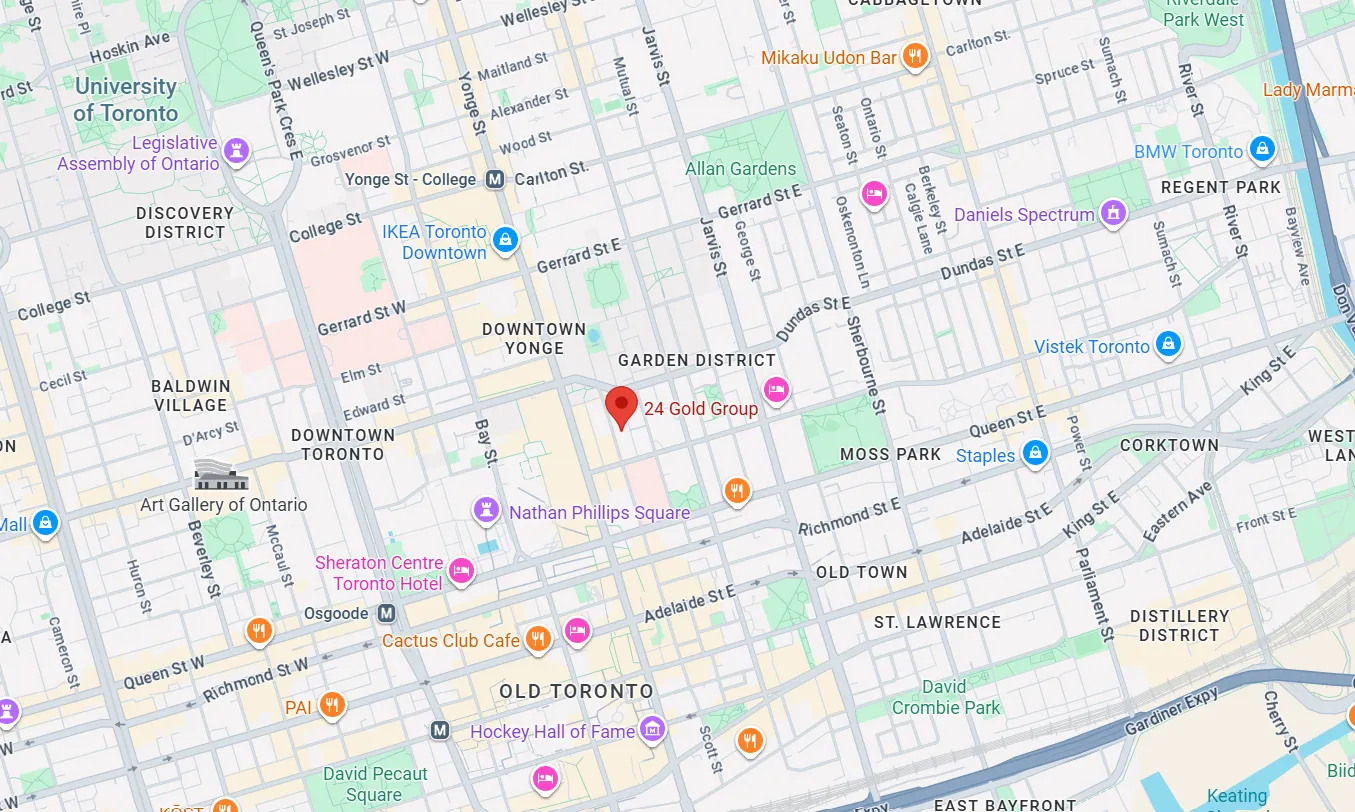
What should I confirm before visiting 24 Gold in Toronto?
Confirm the current address and hours, whether an appointment is recommended, whether your product or material is accepted or available, and what documentation or identification may be required. If buying, confirm price validity and payment or collection arrangements. If selling or refining, ask about the evaluation process and terms. Operational details can change, so check directly before travelling.
Can I ask about a product or material before visiting?
Yes. A preliminary enquiry can help clarify whether a product is available or whether a type of material may be accepted. Provide an accurate description, including any known metal, purity marking, weight or product details, and explain what remains uncertain. An enquiry or estimate should not be treated as a final quote unless the business explicitly confirms that status.
What if I am not sure whether to sell, buy or refine an item?
Start by explaining what the item is, what you know about its metal content and what outcome you want. A bullion product, a jewellery piece with possible collector value and mixed scrap material may be better suited to different evaluation routes. Ask what process applies and what the business can assess. If an item may have significant antique, designer or gemstone value, consider independent specialist advice before treating it only as scrap.
Still Have a Question?
Call our Toronto trading floor and we’ll talk you through buying, selling or refining your precious metals.
 Call the Trading Floor
Get the Best Deal for Your Precious Metals
 24 Gold Group Ltd.
- 221 Victoria St, Suite 312, Toronto, Ontario M5B 1V4
 Business hours:
- Mon to Fri:
8:30 AM to 5:00 PM  Phone:
- +1 (855) 214-2442 toll free
+1 (416) 214-2442
+1 (416) 214-2443  Email:
- info@24gold.ca